
A calorie surplus means you eat more calories from food and drink than your body uses. It is the basic setup for intentional weight gain, muscle gain and bulking phases. The goal is simple: eat enough above maintenance to progress, but not so much that the extra calories turn into avoidable fat gain.
Sommaire
Calorie surplus, deficit and maintenance: the three energy states
Calories measure the energy in food and drink. Your body spends that energy on basic functions, digestion, movement, training, recovery and daily activity. When intake is below, equal to or above expenditure, you are in one of three states.
Calculateur de surplus calorique
Note : Un surplus modéré (5-15%) aide à limiter la prise de graisse inutile.
Formule : TDEE × (1 + %/100)
| Energy state | What it means | Common goal | Expected direction |
|---|---|---|---|
| Calorie deficit | You consume fewer calories than you expend. | Weight loss | Body weight tends to decrease. |
| Calorie maintenance | You consume roughly the same calories as you expend. | Maintain current weight | Body weight tends to stay relatively stable. |
| Calorie surplus | You consume more calories than you expend. | Weight gain or muscle gain | Body weight tends to increase. |
In fitness, a calorie surplus is often called a bulking phase. That does not have to mean eating without limits. A productive bulk is usually controlled. Weight gained in a surplus can be muscle, fat, or both. The result depends on how large the surplus is, how well you train, how much protein you eat, how you recover and how closely you watch your progress.
Why maintenance calories matter first
Your maintenance calories are the baseline. If you do not know roughly how much energy keeps your body weight stable, it is hard to set a sensible surplus. Some people are already close to maintenance and only need a small increase. Others are eating below estimated needs and may need to raise intake over a few weeks or more before they begin a formal surplus.
What your body expends before you add calories
Total daily energy expenditure, or TDEE, is the total amount of energy you expend in a day. A calorie surplus starts here. The surplus is not based on a random number, it is based on how much energy your body already uses.
Personalized Weight Loss and Activity Planner, Create a customized calorie and exercise plan to reach your target weight within your desired timeframe using this official tool.
The 3 types of energy expenditure
Energy expenditure is usually divided into 3 types. Resting energy expenditure is the energy used at rest for essential functions such as breathing and blood circulation. Diet-induced energy expenditure is the energy used for digestion, metabolism, absorption and storage of nutrients. Activity energy expenditure covers movement, from structured exercise and sports to walking and household chores.
This is why two people at the same body weight can need very different calorie targets. A strength athlete training several days a week, someone with an active job and someone who is mostly sedentary will not have the same TDEE. Age, body size, training volume and lifestyle all change the number.
A useful way to judge the result is to look at the trend, not a single day. If you add calories and lifts improve, waist changes stay controlled and weight rises gradually, the surplus is doing its job. If the scale jumps fast, training feels sluggish and the waist grows quickly, the surplus is probably too large. That feedback is more practical than chasing one perfect calculator number.
How to calculate a calorie surplus without overcomplicating it
The simplest method has 2 parts: estimate your TDEE, then choose how much above TDEE to eat. Your estimate can come from a calorie calculator, a nutrition app, a coach, or two to three weeks of tracking food intake and body weight until your weight is stable.
Step-by-step calculation
- Estimate maintenance calories. Use your estimated TDEE or your average intake when body weight is stable.
- Choose a moderate surplus. A small surplus of +5–15% helps limit fat gain.
- Set a daily target. Add the surplus to maintenance calories and aim for consistency rather than perfection.
- Track the response. Watch weight, waist circumference and performance, then adjust if the trend is too fast or too slow.
A worked example
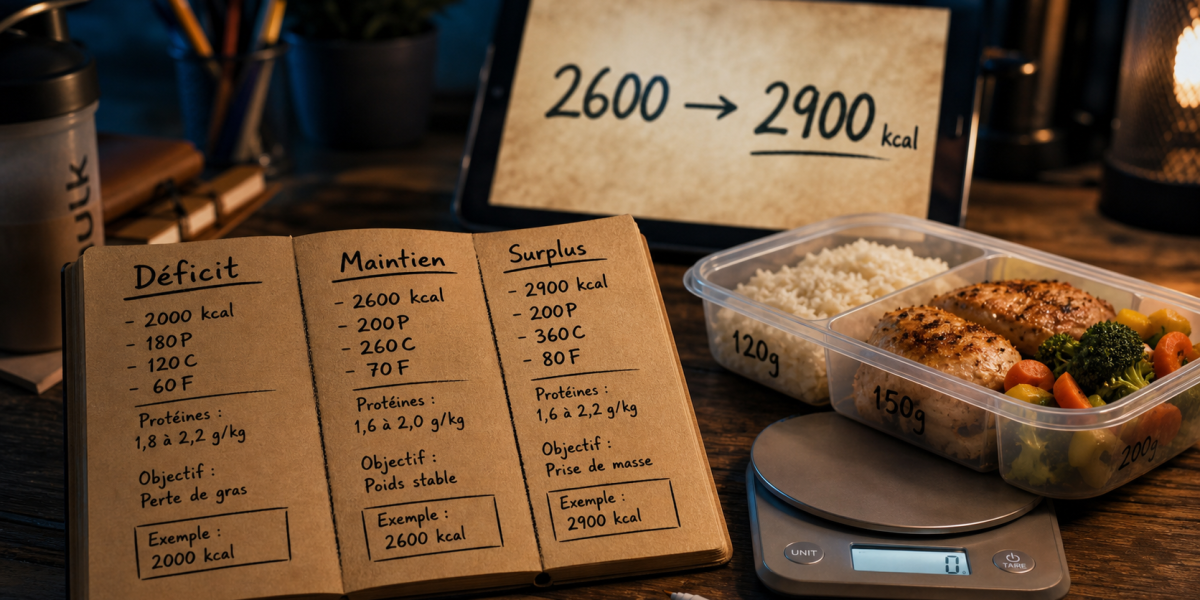
One applied strength athlete example uses a TDEE of 2,600 kcal, raised to 2,900 kcal, which is a +300 kcal surplus. The example runs for 8 weeks, with protein set at 1.8–2.0 g/kg and biweekly checks of weight, waist circumference and performance.
You can use the same logic even if your numbers are different. If your maintenance is 2,200 kcal, a 10% surplus would put you around 2,420 kcal per day. If your maintenance is 3,000 kcal, a 10% surplus would be about 3,300 kcal. The percentage matters because a fixed calorie increase feels very different depending on body size and activity level.
How big should your surplus be for muscle gain?
A moderate surplus is usually more useful than an aggressive one. More calories do not automatically mean more muscle. Your body still needs a training stimulus and enough recovery to use the extra energy well. If the surplus is too large, fat gain can rise faster than lean mass gain.
Use weight gain speed as a guardrail
A typical weekly weight gain range of 0.25% to 0.5% of body weight helps limit fat gain. A gain above 0.5% of body weight is often the point where calories should be reviewed. For an 80 kg person, 0.25% to 0.5% is about 0.2 to 0.4 kg per week. That is slow enough to follow the trend and adjust before the surplus gets out of hand.
Protein, carbs and food quality still matter
A calorie surplus is not a reason to ignore nutrition quality. Protein is usually kept in the range of 1.8–2.2 g/kg. Protein supports lean mass gain, while enough carbohydrates help training performance, especially during strength work or athletic sessions. Fiber and micronutrients still matter for digestion, health and consistency.
- Protein foods: eggs, poultry, fish, lean meat, Greek yogurt, tofu, tempeh, beans and protein-rich dairy.
- Carbohydrate sources: rice, oats, potatoes, pasta, fruit, wholegrain bread and cereals.
- Calorie-dense additions: olive oil, avocado, nut butter, nuts, seeds and smoothies.
- Fiber and micronutrients: vegetables, legumes, fruit, whole grains and varied meals.
If you struggle to eat enough, add calories with simple changes instead of forcing huge meals. Add olive oil to rice, blend a smoothie with milk and nut butter, choose higher-calorie snacks, or spread food across more eating occasions. If weight gain is too fast, reduce the most calorie-dense extras first.
Track, adjust and avoid the mistakes that make surplus messy
A calorie target is only a starting point. Your body’s response tells you whether it is working. The most useful tracking markers are body weight, waist circumference and performance. Every 2–3 weeks is a sensible review rhythm because it is frequent enough to catch trends without reacting to normal daily fluctuations.
What to monitor
- Body weight: use weekly averages rather than one-off weigh-ins.
- Waist circumference: a fast increase can suggest the surplus is too aggressive.
- Training performance: strength, reps, recovery and energy should generally improve or stay productive.
- Protein consistency: hitting your protein range helps support lean mass gain.
- Digestion and appetite: the best surplus is one you can sustain.
Common surplus mistakes
The biggest mistake is starting too high. Jumping far above maintenance may raise scale weight quickly, but it also increases the chance of fat gain. Another mistake is treating bulking as an unrestricted junk-food phase. Calorie-dense foods are useful, but they should still fit into a diet that contains protein, carbohydrates, fiber and micronutrients.
Skipping cardio is another common overreaction. Light cardio can support cardiovascular health and recovery if the surplus is maintained. The issue is not cardio itself, it is failing to account for the energy it uses. If your weight is not rising and you have added more activity, your calorie target may need to increase.
Do not change calories every day. Look at the trend over at least a couple of weeks. If weight is rising faster than the 0.25% to 0.5% weekly range and waist circumference is climbing quickly, reduce intake slightly. If weight is flat, performance is not improving and adherence is solid, add a small amount of calories and check again.
Mis à jour le 11 juillet 2026